Planning
Planning Overview
CCBWQA conducts two general types of planning:
- Strategic planning related to its mission and goals and;
- Specific project planning for pollution abatement projects.
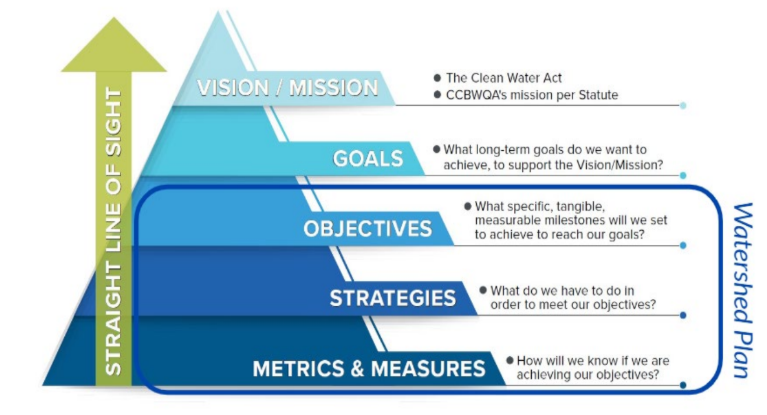
Vision, Mission, Goals, and Objectives
Vision:
Restore and maintain the chemical, physical, and biological integrity of state waters in the Cherry Creek Reservoir Basin.
Mission:
- Improve, protect, and preserve water quality in Cherry Creek and Cherry Creek Reservoir for recreation, fisheries, water supplies, and other beneficial uses.
- Provide for effective efforts by counties, municipalities, special districts, and landowners within the basin in the protection of water quality.
- Promote public health, safety, and welfare.
Goals:
- Use effective stewardship to implement sustainable reservoir and watershed water quality management strategies.
- Implement an efficient and effective organization with the expertise to achieve results.
- Work with member entities and stakeholders to enhance partnerships on water quality policies and projects.
- Continue to develop leading edge, innovative water quality solutions.
- Adapt as needed.
Objectives:
- Better understand reservoir and watershed dynamics and linkages.
- Identify the right "mix" of sustainable strategies that will preserve and enhance water quality for beneficial uses and/or prevent negative water quality impacts.
- Assist the CCBWQA Board in maintaining an adaptable organizational structure and expertise to efficiently identify, prioritize, and implement initiatives and respond to requests.
- Enhance partnerships with member entities and stakeholders to leverage resources, resulting in improvement, protection, and/or preservation of water quality beneficial uses, and prevention of negative water quality impacts.
- Effectively and efficiently participate in regulatory activities that impact water quality.
- Continue as leader and laboratory.
Pollution Abatement Project Planning
CCBWQA plans for future Pollution Abatement Projects. These planning efforts help to identify future projects, estimate water quality benefits, and inform prioritization for inclusion in the 10-year Capital Improvement Program.
- Sulphur Gulch, Tallman Gulch and Tributaries Urban Stream Study: In 2025, ICON Engineering completed components of the initial study phase, including a field conditions assessment for Tallman Gulch. Field assessments for the remaining tributaries will be completed in a subsequent phase of work. ICON also completed the hydrologic analysis for all tributaries and approximately 90 percent of the hydraulic modeling. In 2026, ICON will initiate the detailed stream assessment for Tallman Gulch followed by the Sulphur Gulch and other tributaries.
Emerging Regulatory Issues
CCBWQA continues to track regulatory developments related to lake nutrient standards under Regulation 38. During the WQCC’s 2023 Lakes Nutrients Criteria rulemaking hearing, chlorophyll-a standards were adopted for lakes and reservoirs 25 acres or larger statewide. Cherry Creek Reservoir already had an established chlorophyll-a standard at that time, and no changes were made. Total phosphorus (TP) and total nitrogen (TN) standards were adopted only for certain reservoirs upstream of qualified permitted wastewater dischargers; therefore, no TP or TN standards were adopted for Cherry Creek Reservoir.
At the conclusion of the 2023 rulemaking, the WQCC indicated its intent to revisit statewide lake nutrient standards in a future hearing originally anticipated in 2027. More recent communication from the Water Quality Control Division indicates that a statewide proposal is now unlikely before 2030 at the earliest.
CCBWQA intends to pursue site-specific TP and TN standards for Cherry Creek Reservoir in a future Regulation 38 rulemaking, reflecting the unique conditions of the Cherry Creek watershed. An initial concept was shared with the WQCD, EPA, and Colorado Parks and Wildlife in 2023; however, at the WQCD’s request, further advancement has been deferred to allow refinement of feasibility and implementation considerations, including how nutrient standards would be incorporated into discharge permits, as part of CDPHE’s 10-Year Water Quality Roadmap.