2025 Annual Report on Activities
Cherry Creek Basin Water Quality Authority
- How is the Reservoir?
- How is the watershed?
- What did we do to preserve water quality?
- What we learned from studies and special projects conducted in 2025
- What are our plans for 2026?
Some links in the Annual Report contain public documents. The CCBWQA is committed to providing accessible content to the public as outlined in our Website Accessibility Statement. Historic internal CCBWQA content posted to the website prior to July 1, 2024 has been archived and all current documents have been remediated to applicable WCAG 2.1, Level A standards or above. If need help accessing internal CCBWQA content, call us at 303.968.9098 or email us at manager@ccbwqa.org.
Key Takeaways from Water Year 2025 (10/1/2024– 9/30/2025)
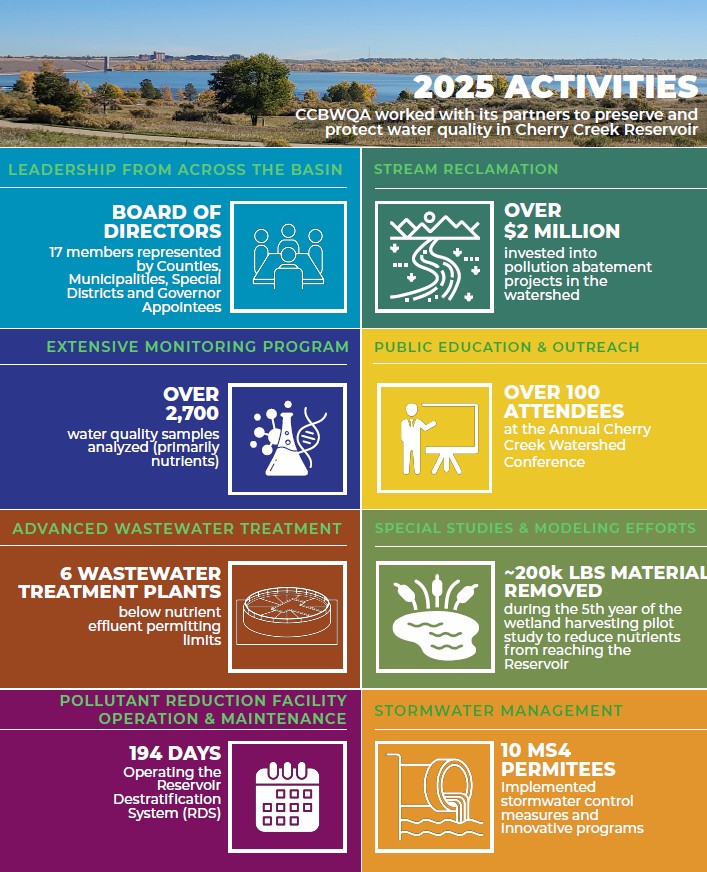
During 2025, the Cherry Creek Basin Water Quality Authority (CCBWQA) worked with its partners to preserve and protect water quality in Cherry Creek Reservoir (reservoir). This work includes an extensive reservoir and watershed monitoring program, stream reclamation projects, operation and maintenance of Pollutant Reduction Facilities, operation of the Reservoir Destratification System, special studies and modeling efforts, public education and outreach, and other efforts. Local governments and entities operating wastewater reclamation facilities use advanced treatment technology to maintain total phosphorus in treated effluent at 30-day average concentrations below 0.05 mg/L. Municipal stormwater managers implement stormwater management programs in accordance with Regulation 72 requirements to minimize the adverse effects of stormwater runoff on streams and the reservoir.
Highlights of our 2025 activities are briefly summarized below.
How is the Reservoir?
Cherry Creek State Park has a record number of visitors every year, and the reservoir continues to provide space where people enjoy recreating and connecting. Colorado Parks and Wildlife biologists reported that the walleye fishery is doing well.
Seasonal phosphorus concentrations in the reservoir were well above the interim criteria and were higher than the long-term median for Cherry Creek Reservoir. Despite ongoing efforts to reduce nutrient loading to the reservoir, the reservoir did not attain its chlorophyll-a standard of 18 ug/L during 2025. The average chlorophyll-a concentration was 23.1 ug/L for the growing season of July through September. Chlorophyll-a concentrations above 20 ug/L commonly correspond to nuisance conditions (Walmsley and Butty, 1979). Additionally, caution signs due to an undesirable blue-green algae bloom in early July were posted to notify the public of the potential risk. The bloom and associated toxins were only detected for a few days and toxins were below recreational thresholds. The reservoir did attain the Regulation 38 aquatic life water quality standards for temperature, pH, and dissolved oxygen.
Some of the factors affecting conditions in the reservoir are challenging or impossible to control and result in year-to-year variations in water quality and environmental conditions.
Some of these factors include weather conditions such as temperature, wind, and precipitation patterns. The reservoir received below average annual precipitation in 2025, with significantly lower rain than average from May through July. Other factors include natural sources of phosphorus loading from the watershed and alluvial groundwater and the release of stored nutrients from reservoir sediments (internal loading). CCBWQA operates a Reservoir Destratification System from April through October to help mix the water and mitigate some of these influences.
How is the watershed?
The 386 square mile watershed has experienced significant growth since Control Regulation 72 was implemented. Baseline loading of phosphorus from wastewater reclamation facilities is well controlled, with these point sources contributing less than three percent of the phosphorus load to the reservoir.
CCBWQA monitors phosphorus and nitrogen concentrations in Cherry Creek and Cottonwood Creek since they are the two main inflows to the reservoir.
Key findings from 2025 include:
- Median total phosphorus concentrations in baseflows and storm flows were lower than long term medians for both Cherry Creek and Cottonwood Creek
- Phosphorus concentrations in Cottonwood Creek are ~ 60% lower than concentrations in Cherry Creek.
- Total nitrogen concentrations in both Cherry Creek and Cottonwood Creek were slightly higher than the long term historical median.
- Median nitrogen concentrations in Cherry Creek were 50% lower than concentrations in Cottonwood Creek in base flows.
- The CCBWQA pollutant reduction facilities (PRFs) on Cottonwood Creek are effectively reducing phosphorus and suspended solids during storm flows.
- Median nutrient concentrations are lower downstream of the stream reclamation project on McMurdo Gulch.
What did we do to preserve water quality?
CCBWQA and its partners continue to implement pollutant reduction facilities and stormwater control measures, construct stream reclamation projects and conduct other activities to reduce nutrient loading throughout the watershed. Key 2025 capital improvement projects in the watershed include:
- East Shade Shelter Stabilization Project: In 2025 the East Shade Shelter Stabilization Project construction was completed along the east bank of the reservoir in the Cherry Creek state park. The project was estimated to immobilize 45 pounds annually of phosphorus loading to the reservoir. This project was CCBWQA led this project with partnership from CPW.
- SEMSWA Water Quality Pond W6/7 Retrofit Project: In 2025 the SEMSWA pond W6/7 retrofit project construction was completed. The project is located along Windmill creek and is the regional facility for 395 tributary acres. Retrofit improvements to the pond were made which were estimated to remove 5.1 to 11.4 pounds of phosphorus annually. The project was led by SEMSWA led this project with CCBWQA partnership funding.
- Cherry Creek at Scott Road Stream Stabilization Project: In 2025 the Cherry Creek at Scott Road stream stabilization project was completed. The project is located along Cherry Creek in Douglas County. Its estimated that improvements will immobilize up to 73 pounds of phosphorus to Cherry Creek and Cherry Creek Reservoir annually. The project was led by MHFD with both Douglas County and CCBWQA partnership funding.
- Cherry Creek at Dransfeldt Stream Stabilization Project: In 2025 the Cherry Creek at Dransfeldt stream stabilization project was completed. The project is located along Cherry Creek in the Town of Parker. It is estimated that improvements will immobilize up to 41 pounds of phosphorus to Cherry Creek and Cherry Creek Reservoir annually. The project was led by MHFD with Town of Parker and CCBWQA partnership funding. The project also won an APWA Colorado Chapter award for Medium Community Environment category.
- Cherry Creek Reach 1 (Reservoir to Lakeview Road): In 2025 the design for this project was completed through conceptual design (30%) and continued to progress through preliminary design (60%) to be completed in January 2026. The project plans to continue to progress in 2026 to final design.
What We Learned
During 2025, CCBWQA conducted several special studies including:
- Stormwater Best Management Practice (BMP) Effectiveness Study: In March 2025, CCBWQA concluded a study to synthesize the most current information on the expected effectiveness of stormwater BMPs (also known as stormwater control measures). Based on findings from this study, CCBWQA is pursuing follow-up work to fill data gaps regarding the performance of receiving pervious areas, identify opportunities for and benefits of pond retrofits, and further evaluate the stormwater quality “level of service” provided in older developed areas.
- Wetlands Harvesting Project: In 2025, CCBWQA completed year four of a six-year pilot project to evaluate whether cutting and disposing of wetland vegetation will help to reduce phosphorus and nitrogen from being carried to Cherry Creek Reservoir after the plants decay.
What are our plans for 2026?
CCBWQA will continue its routine activities along with some new activities in 2026. Highlights include:
- Continue the extensive long-term monitoring program that includes: weather and stream flow conditions; water quality in the reservoir, groundwater, Cherry Creek and Cottonwood Creek, and other tributaries; Pollutant Reduction Facility performance; and phytoplankton and zooplankton dynamics in the reservoir.
- Invest $2.8 million in stream reclamation projects in the watershed. These include projects on Cherry Creek, Lone Tree Creek, Happy Canyon, and Piney Creek.
- Complete preliminary and final design of Cherry Creek Reach 1 just upstream of the Reservoir to determine feasibility of restoration phasing, timing, and funding.
- Continue the wetland harvesting pilot project on Cottonwood Creek to quantify the water quality benefit in addition to nutrient removal in the biomass.
- Implement the new Watershed Plan which integrates geospatial data from multiple partners into CCBWQA's Data Portal.
- Continue to host the Cherry Creek Stewardship Partners annual watershed conference to share information on all the exciting projects in and around the basin supporting watershed health.
- Determine the optimal operation of the Reservoir Destratification System based on water levels and conditions.
- Continue sharing information and communication with sister watersheds on the Front Range, including Bear Creek, Chatfield, and Barr-Milton Watershed Organizations and the recently formed South Platte Urban Partnership initiative.
- Complete feasibility study for in-reservoir strategies to reduce internal phosphorus loading in Cherry Creek Reservoir.